
Why your Bank or Financial Institution should purchase Physical Gold Bullion
Explore the strategic advantages of integrating gold into your financial portfolio to bolster stability and resilience.
Gold as a Strategic Asset
Enhancing Financial Resilience
Optimizing Capital Buffers

The Role of Gold in the Basel III Framework
Gold: A Pillar of Financial Stability for Banks
Gold plays a crucial role in the Basel III framework by acting as a stable asset that enhances a bank’s balance sheet resilience during periods of financial stress. Its intrinsic value and historical reliability make it an ideal choice for institutions looking to safeguard their capital against market volatility. By incorporating gold, banks can maintain robust capital ratios, ensuring they meet regulatory requirements while protecting against economic downturns.
Incorporating gold into financial strategies provides a buffer against market fluctuations, offering a reliable asset that supports financial stability. Its unique properties make it a preferred choice for institutions aiming to strengthen their financial standing in uncertain times.
Diversification Benefits of Gold
Mitigating Currency Reliance with Gold
Using gold as part of liquidity and capital buffers provides significant diversification benefits, reducing reliance on any single currency. This strategy is particularly advantageous during periods of monetary uncertainty, as it allows institutions to hedge against currency risks and maintain financial stability. By diversifying reserves with gold, banks can enhance their resilience and ensure a more balanced and secure financial position.
Navigating Gold's Role in Banking
Incorporating gold into a bank’s capital strategy requires careful consideration of several trade-offs. The Net Stable Funding Ratio (NSFR) assigns an 85% Required Stable Funding (RSF) factor to physical gold, necessitating substantial long-term funding. This makes gold more funding-intensive compared to other liquid assets. This long-term funding requirement is balanced by the substantial and constant increase in the price of gold as seen since 2025, in favor of holding Allocated Gold as a Tier-1 Asset and is seen as a strong benefit without compromising financial stability.
Balancing Gold in Capital Strategy

Importance of Basel III Framework in Gold Management

Meeting Basel III regulations on gold assets is crucial for banks, as it directly impacts their capital ratios and funding costs. Basel III’s stringent requirements ensure that gold is treated as a high-quality capital asset, influencing how banks structure their balance sheets. Compliance with these regulations helps banks optimize their capital adequacy by allowing Allocated Physical Gold to be a Tier-1 Asset, risk-weighted at 0%, thus supporting efficient capital ratios. Non-compliance, on the other hand, can lead to increased funding costs and regulatory penalties, affecting a bank’s financial health and operational capabilities.
Understanding Gold Allocation
Critical Impact of Gold Allocation on Capital Adequacy

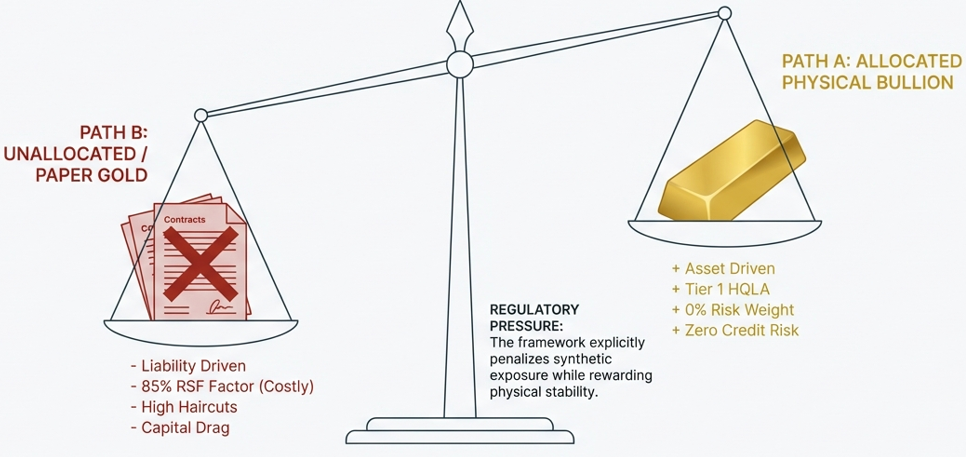
In the context of Basel III regulations, the distinction between Allocated and Unallocated gold is crucial for banks aiming to optimize their capital adequacy. Allocated gold, being a physical asset, is treated as a zero-risk weight item, enhancing a bank’s capital ratios efficiently. This contrasts with Unallocated gold, which incurs higher risk and funding charges, potentially straining capital resources. By strategically managing these assets, banks can maintain a robust capital structure, ensuring compliance with regulatory requirements while maximizing asset efficiency.
Navigating Funding Challenges
Funding Costs and NSFR Pressures in Gold Management
Banks face significant funding challenges when managing gold positions under Basel III, primarily due to the 85% Required Stable Funding (RSF) factor imposed on physical gold. This necessitates long-term, stable funding, increasing the cost of holding gold assets. As a result, banks must carefully evaluate their business models to ensure economic viability. Failure to meet these funding requirements can lead to increased operational costs, potentially impacting profitability. Therefore, strategic planning and efficient funding management are essential for sustaining a competitive edge in the precious metals market.
Enhancing Client Services
Market Access and Client Services in Gold Asset Management
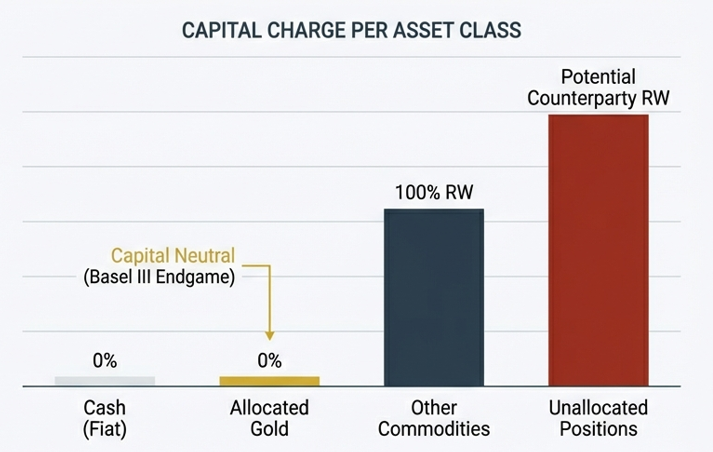
In the realm of gold asset management, maintaining market access and delivering exceptional client services are pivotal for banks under Basel III compliance. Properly managing Allocated versus Unallocated Gold allows banks to offer comprehensive services such as custody, trading, and hedging without breaching liquidity or capital limits. This compliance not only safeguards a bank’s reputation but also strengthens relationships with institutional clients and regulators. By ensuring full alignment with Basel III standards, banks can enhance their market position, attract new business, and mitigate the risk of losing clients to more compliant competitors.
Systemic Stability Goals
Understanding Basel III and Gold
The Basel III framework plays a crucial role in enhancing systemic stability by integrating gold as a key component of bank capital. By recognizing physical gold as a high-quality capital asset, Basel III aims to reduce systemic risk and promote financial resilience. This approach encourages banks to maintain a balanced mix of assets, thereby minimizing the potential for liquidity shocks and ensuring long-term stability. The policy goals are clear: to create a more transparent and robust financial system where gold serves as a reliable buffer against economic uncertainties.

Why Work with Blue Lotus Projects
If you are a Bank or a Large Institutional Buyer looking to purchase Gold for the Bank itself or for one of your Tier-1 Clients Contact Us
At Blue Lotus Projects, we offer customized purchase programs that immediately capitalize your bank with a Tier-1 Asset, in alignment with Basel III regulations, ensuring your institution meets all compliance requirements Efficiently and Cost-Effectively. Our team of experts is ready to assist you in structuring a SPOT purchase or a program of regular monthly purchases over a 1 or 2 year period that suits your specific needs, providing both stability and competitive pricing. Reach out today to explore how we can support your gold purchase strategies
Why Blue Lotus Projects - Click on Any Item for Details
We are the Seller Mandate for Sellers with VERY large available inventory
We are the Designated Mandate for a very large Mining Consortium ready to Sell Hallmark Gold Bullion with an available inventory for immediate delivery in the Tens of Metric Tons of Gold – despite any Headlines you might see talking about supply shortages
Recognized International Hallmarks
Our Seller has very large inventory of Gold Bullion with recognized International Hallmarks in Private Vaulting. This inventory, already in vaulting, largely exceeds any monthly refinery capacity
Discounted Gold Bullion Prices
Our Hallmark Gold Bullion prices are substantially discounted (depending on quantities) against the standard published LBMA market prices
Our Own Fleet of Transport Planes
Our Seller has its own fleet of transport planes that can deliver Gold Bullion Bars, CIF to any International Airport in the World: 5-Days a Week / 52-Weeks a Year

IF YOU ARE A BANK OR A LARGE INSTITUTIONAL BUYER CONTACT US BY CLICKING HERE
Use our Contact Form to Request More Information
Give us as much details as possible about your Gold Purchase plans and we will be happy to start our conversation by emailing you a PDF document with our detailed explanations why your Bank should purchase Hallmark Gold Bullion as an Allocated Asset
The FAQ below is provided for the Education and Benefit of Senior Risk and Treasury Leadership to help them navigate the complex environment of Physical Gold
Click on Any Item of Interest to you to Read the Content
Why banks are incentivized to hold Gold Bullion
Strategic Gold – “Basel III and Gold” (focus on physical, Allocated Gold, zero‑risk weight
A new gold‑backed monetary system?
Is Basel III setting up a new gold‑backed monetary system? This explains gold’s move from Tier 3 to much more favorable treatment and implications for banks and reserves.
https://www.mining.com/is-basel-iii-setting-up-a-new-gold-backed-monetary-system/
Gold and Basel III
Basel III provides for preferential treatment for Physical vs Paper Gold, NSFR and 85% stable funding requirement
https://www.efginternational.com/us/insights/2021/gold-and-basel.html
The impact of Basel III on the gold market
Summarizes reclassification of Physical Allocated Gold as top‑tier and how that changes bank incentives
https://www.11onze.cat/en/magazine/impact-basel-gold-market/
How Basel III Changes the Game for Institutional Investors
Why paper gold is less attractive and pushes banks toward Physical Bullion
https://cmi-gold-silver.com/tier-1-asset-status-basel-iii-changes-the-game/
Basel III and Gold
Easy‑to‑read explanation of why banks may convert Paper Gold to Physical Bullion to meet reserve rules
How does physical gold help banks improve their capital ratios?
Explains how Gold has evolved to become a Tier-1 Reserve Asset
https://graniteshares.com/institutional/us/en-us/research/is-gold-a-tier-1-asset/